12 illustration(s) from this book
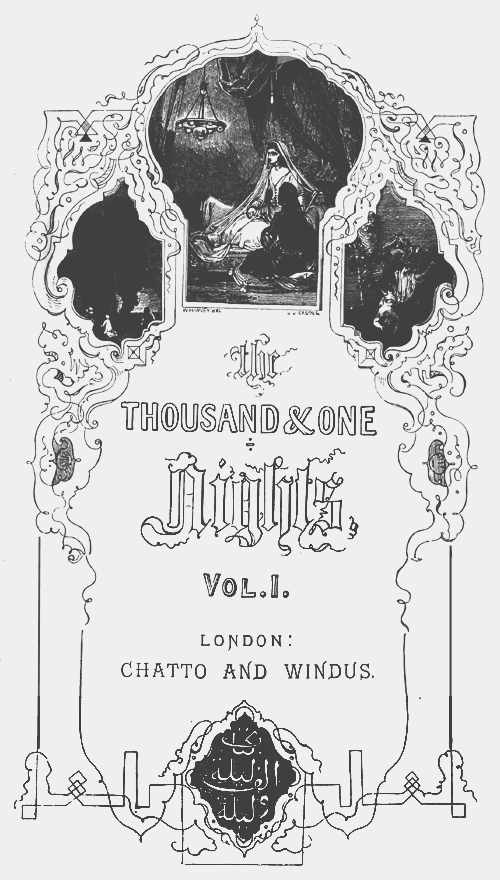

The actual moment is an opportune one for the reappearance of the work.
Egypt just now holds a foremost place in the eyes of the world, and it
is of Egypt that the _Thousand and One Nights_ have most to tell. Indian
or Persian as many of the tales are in their origin, their setting is
almost purely Egyptian; and though the place may be nominally Baghdád or
India, or even furthest China, it is in mediæval Cairo, in the days of
the Memlooks, that the scene of the Arabian Nights is really laid. The
people described are not Hindoos or Chinese, but Arabs and Egyptians as
they lived and moved in the fifteenth century, when some of the
beautiful mosques and tombs, that still make Cairo the delight of
artists, were being built, and the devastating hand of the Ottoman Turk
had not yet been laid on the land of the Pharaohs. For a minute picture
of Arabian society as it was in the Middle Ages, the _Thousand and One
Nights_ have no rival, and it is Mr. Lane's appreciation of this
picture, and the wealth of illustration lavished upon it in his Notes,
that render his edition the most complete commentary we possess on
Muslim life and manners, religion and literature, and make it an
indispensable supplement to his famous _Account of the Manners and
Customs of the Modern Egyptians_. The poetry of Eastern life is rapidly
fading away under the effacing touch of European civilisation; the
characteristic society in which an Haroon-Er-Rasheed, an Aboo-Nuwas, a
Káfoor, a Saladin, or a Kaït-Bey, revelled and jested and conquered, is
fast becoming matter of history rather than of experience, a field for
the antiquary instead of the traveller; and it is well that we can
reconstruct it in the pages of the _Thousand and One Nights_, whose
compiler saw it when it was still almost in its Golden Prime, and in the
_Modern Egyptians_, whose author knew it when it still preserved the
romantic character which has charmed and fascinated readers of every age
and condition.