12 illustration(s) from this book







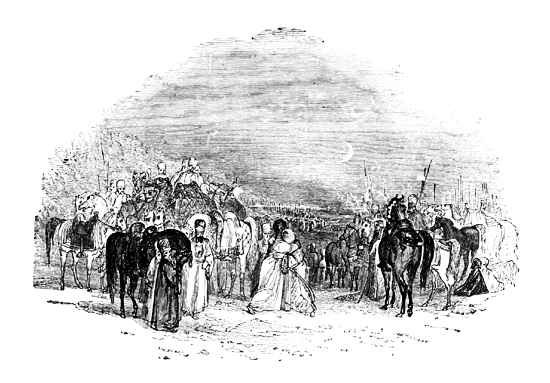
1. Prayer (eṣ-ṣaláh, commonly pronounced eṣ-ṣalah), including
preparatory purifications. There are partial or total washings to be
performed on particular occasions which need not be mentioned. The
ablution which is more especially preparatory to prayer (and which is
called wuḍoó) consists in washing the hands, mouth, nostrils, face, arms
(as high as the elbow, the right first), each three times; and then the
upper part of the head, the beard, ears, neck, and feet, each once. This
is done with running water, or from a very large tank, or from a lake,
or the sea.--Prayers are required to be performed five times in the
course of every day; between daybreak and sunrise, between noon and the
'aṣr (which latter period is about mid-time between noon and nightfall),
between the 'aṣr and sunset, between sunset and the 'eshè (or the period
when the darkness of night commences), and at, or after, the 'eshè. The
commencement of each of these periods is announced by a chant (called
adán), repeated by a crier (muëddin) from the mád'neh, or menaret, of
each mosque; and it is more meritorious to commence the prayer then than
at a later time. On each of these occasions, the Muslim has to perform
certain prayers held to be ordained by God, and others ordained by the
Prophet; each kind consisting of two, three, or four "rek'ahs;" which
term signifies the repetition of a set form of words, chiefly from the
Ḳur-án, and ejaculations of "God is most Great!" &c., accompanied by
particular postures; part of the words being repeated in an erect
posture; part, sitting; and part, in other postures: an inclination of
the head and body, followed by two prostrations, distinguishing each
rek'ah. These prayers may in some cases be abridged, and in others
entirely omitted. Other prayers must be performed on particular
occasions. 1. On Friday, the Mohammadan Sabbath. These are
congregational prayers, and are similar to those of other days, with
additional prayers and exhortations by a minister, who is called Imám,
or Khaṭeeb. 2. On two grand annual festivals. 3. On the nights of
Ramaḍán, the month of abstinence. 4. On the occasion of an eclipse of
the sun or moon. 5. For rain. 6. Previously to the commencement of
battle. 7. In pilgrimage. 8. At funerals.