12 illustration(s) from this book


[108] Manṭiḳ eṭ-ṭeyr.
[109] Of the family _Pteroclidæ_. (Pr. Bon.) ED.
[110] Ibn-'Arab-Sháh, however, has given an account of a man
called the sheykh El-'Oryán, an inhabitant of Samarḳand, and a
devotee, who was said to have attained the age of 350 [lunar]
years [or nearly 340 solar years], and yet preserved an erect
stature, a comely appearance, and such strength that it seemed
as if he had not attained to mature years. The old men of the
place asserted that they remembered him to have had the same
appearance when they were children, and that their fathers and
grandfathers had said the same.--History of Teemoor, p. 470,
Calcutta edition.
CHAPTER I.
COMMENCING WITH THE FIRST NIGHT, AND ENDING WITH PART OF THE THIRD.
THE STORY OF THE MERCHANT AND THE JINNEE.
It has been related to me, O happy King, said Shahrazád, that there was
a certain merchant who had great wealth, and traded extensively with
surrounding countries; and one day he mounted his horse, and journeyed
to a neighbouring country to collect what was due to him, and, the heat
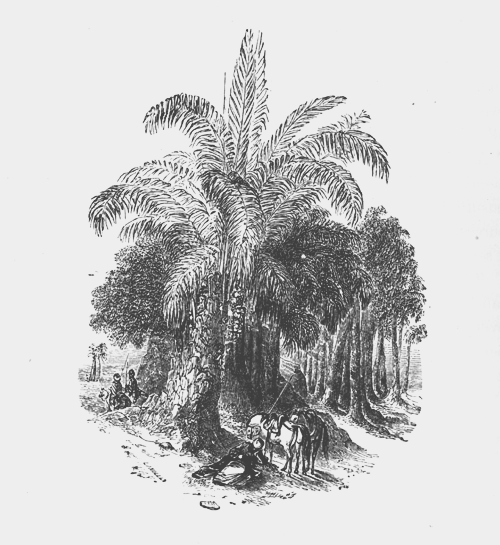
oppressing him, he sat under a tree, in a garden,[I_1] and put his
hand into his saddle-bag,[I_2] and ate a morsel of bread and a date
which were among his provisions. Having eaten the date, he threw aside
the stone,[I_3] and immediately there appeared before him an
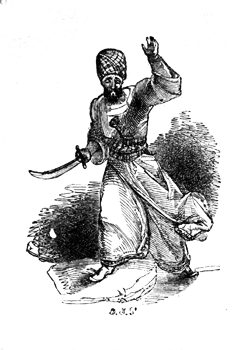
'Efreet, of enormous height, who, holding a drawn sword in his hand,
approached him, and said, Rise, that I may kill thee, as thou hast
killed my son. The merchant asked him, How have I killed thy son? He
answered, When thou atest the date, and threwest aside the stone, it
struck my son upon the chest,[I_4] and, as fate had decreed against
him, he instantly died.[I_5]
[Illustration]