12 illustration(s) from this book







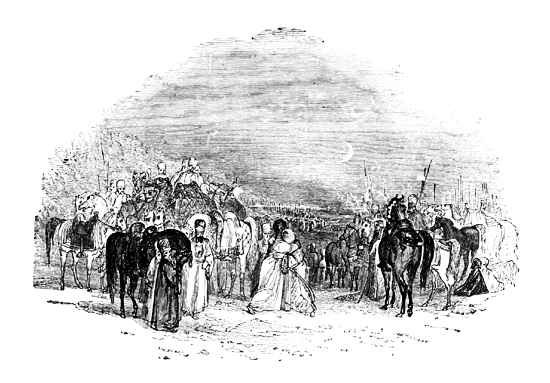
The exordium of the present work, showing the duty imposed upon a Muslim
by his religion, even on the occasion of his commencing the composition
or compilation of a series of fictions, suggests to me the necessity of
inserting a brief prefatory notice of the fundamental points of his
faith, and the principal laws of the ritual and moral, the civil, and
the criminal code; leaving more full explanations of particular points
to be given when occasions shall require such illustrations.
The confession of the Muslim's faith is briefly made in these
words:--"There is no deity but God: Moḥammad is God's Apostle:"--which
imply a belief and observance of everything that Moḥammad taught to be
the word or will of God. In the opinion of those who are commonly called
orthodox, and termed "Sunnees" (the only class whom we have to consider;
for they are Sunnee tenets and Arab manners which are described in this
work in almost every case, wherever the scene is laid), the Mohammadan
code is founded upon the Ḳur-án, the Traditions of the Prophet, the
concordance of his principal early disciples, and the decisions which
have been framed from analogy or comparison. This class consists of four
sects, Ḥanafees, Sháfe'ees, Málikees, and Ḥambelees; so called after the
names of their respective founders. The other sects, who are called
"Shiya'ees" (an appellation particularly given to the Persian sect, but
also used to designate generally all who are not Sunnees), are regarded
by their opponents in general nearly in the same light as those who do
not profess El-Islám (or the Mohammadan faith); that is, as destined to
eternal or severe punishment.
The Mohammadan faith embraces the following points: