12 illustration(s) from this book





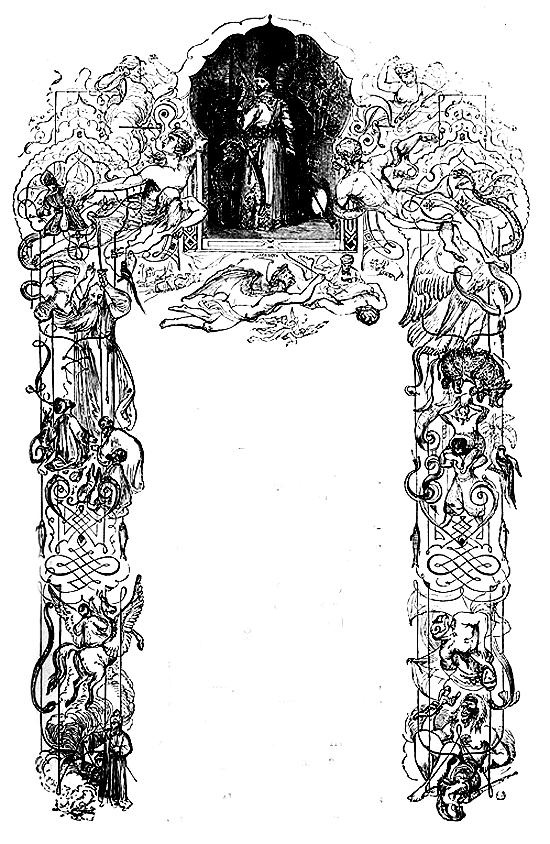
"It is believed," says El-Ḳazweenee, "that the Angels are of a simple
substance, endowed with life, and speech, and reason; and that the
difference between them and the Jinn and Sheyṭáns is a difference of
species. Know," he adds, "that the Angels are sanctified from carnal
desire and the disturbance of anger: they disobey not God in what He
hath commanded them, but do what they are commanded. Their food is the
celebrating of his glory; their drink, the proclaiming of his holiness;
their conversation, the commemoration of God, whose name be exalted;
their pleasure, his worship: they are created in different forms, and
with different powers." Some are described as having the forms of
brutes. Four of them are Archangels; Jebraeel or Jibreel (or Gabriel),
the angel of revelations; Meekaeel or Meekál (or Michael), the patron of
the Israelites; 'Azraeel, the angel of death; and Isráfeel, the angel of
the trumpet, which he is to sound twice, or as some say thrice, at the
end of the world: one blast will kill all living creatures (himself
included): another, forty years after, (he being raised again for this
purpose, with Jebraeel and Meekaeel), will raise the dead. These
Archangels are also called Apostolic Angels. They are inferior in
dignity to human prophets and apostles, though superior to the rest of
the human race: the angelic nature is held to be inferior to the human
nature, because all the Angels were commanded to prostrate themselves
before Adam. Every believer is attended by two guardian and recording
angels; one of whom writes his good actions; the other, his evil
actions: or, according to some, the number of these angels is five, or
sixty, or a hundred and sixty. There are also two Angels called Munkar
(vulg. Nákir) and Nekeer, who examine all the dead, and torture the
wicked, in their graves.