12 illustration(s) from this book


"My undertaking to translate anew the Tales of 'The Thousand and One
Nights' implies an unfavourable opinion of the version which has so long
amused us; but I must express my objections with respect to the latter
in plain terms, and this I shall do by means of a few words on the
version of Galland, from which it is derived; for to him alone its chief
faults are to be attributed. I am somewhat reluctant to make this
remark, because several persons, and among them some of high and
deserved reputation as Arabic scholars, have pronounced an opinion that
his version is an _improvement_ upon the original. That 'The Thousand
and One Nights' may be greatly improved, I most readily admit; but as
confidently do I assert that Galland has excessively _perverted_ the
work. His acquaintance with Arab manners and customs was insufficient to
preserve him always from errors of the grossest description, and by the
_style_ of his version he has given to the whole a false character, thus
sacrificing, in a great measure, what is most valuable in the original
work,--I mean its minute accuracy with respect to those peculiarities
which distinguish the Arabs from every other nation, not only of the
West, but also of the East. Deceived by the vague nature of Galland's
version, travellers in Persia, Turkey, and India, have often fancied
that the Arabian Tales describe the particular manners of the natives of
those countries; but no one who has read them in the original language,
having an intimate acquaintance with the Arabs, can be of this opinion:
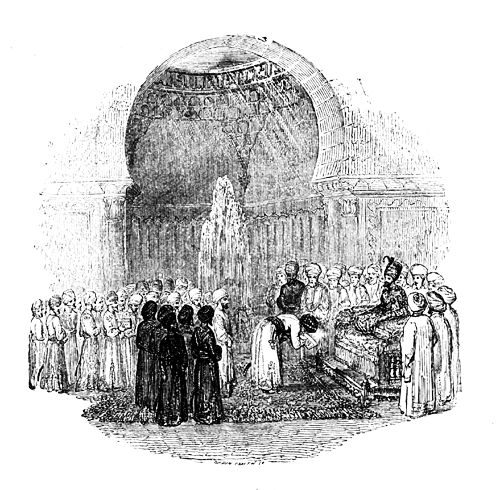
it is in Arabian countries, and especially in Egypt, that we see the
people, the dresses, and the buildings, which it describes in almost
every case, even when the scene is laid in Persia, in India, or in
China.