12 illustration(s) from this book

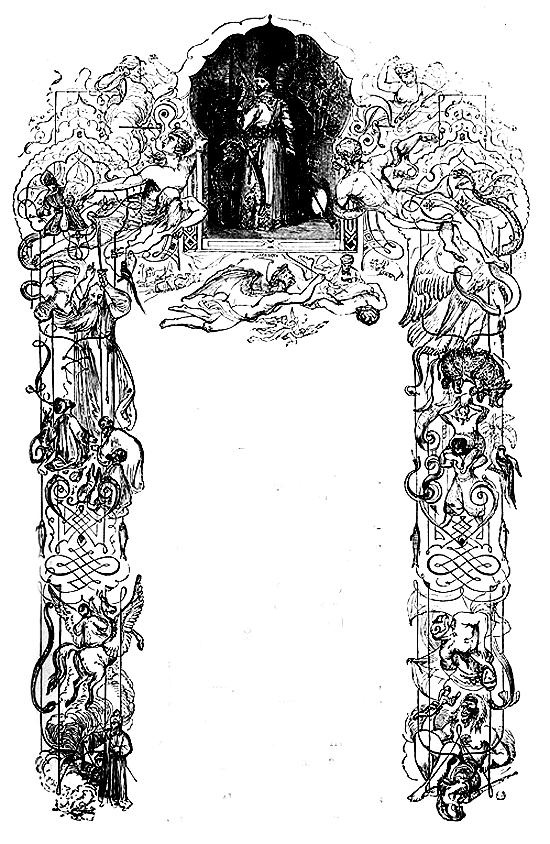
"Iblees," we are told by another authority, "was sent as a governor upon
the earth, and judged among the Jinn a thousand years, after which he
ascended into heaven, and remained employed in worship until the
creation of Adam."[65] The name of Iblees was originally, according to
some, 'Azázeel (as before mentioned); and according to others,
El-Ḥárith: his patronymic is Aboo-Murrah, or Abu-l-Ghimr.[66]--It is
disputed whether he was of the Angels or of the Jinn. There are three
opinions on this point.--1. That he was of the Angels, from a tradition
from Ibn-'Abbás.--2. That he was of the Sheyṭáns (or evil Jinn); as it
is said in the Ḳur-án, "except Iblees, [who] was [one] of the Jinn:"
this was the opinion of El-Ḥasan El-Baṣree, and is that commonly
held.--3. That he was neither of the Angels nor of the Jinn; but created
alone, of fire.--Ibn-'Abbás founds his opinion on the same text from
which El-Ḥasan El-Baṣree derives his: "When we said unto the Angels,
Worship ye Adam, and [all] worshipped except Iblees, [who] was [one] of
the Jinn" (before quoted): which he explains by saying, that the most
noble and honourable among the Angels are called "the Jinn," because
they are _veiled_ from the eyes of the other Angels on account of their
superiority; and that Iblees was one of these Jinn. He adds, that he had
the government of the lowest heaven and of the earth, and was called the
Ṭáoos (literally, Peacock) of the Angels; and that there was not a spot
in the lowest heaven but he had prostrated himself upon it: but when the
Jinn rebelled upon the earth, God sent a troop of Angels who drove them
to the islands and mountains; and Iblees being elated with pride, and
refusing to prostrate himself before Adam, God transformed him into a
Sheyṭán.--But this reasoning is opposed by other verses, in which Iblees
is represented as saying, "Thou hast created _me_ of _fire_, and hast
created _him_ [Adam] of _earth_."[67] It is therefore argued, "If he
were created originally of fire, how was he created of light? for the
Angels were [all] created of light."[68]--The former verse may be
explained by the tradition, that Iblees, having been taken captive, was
exalted among the Angels; or perhaps there is an ellipsis after the word
"Angels;" for it might be inferred that the command given to the Angels
was also (and _à fortiori_) to be obeyed by the Jinn.