12 illustration(s) from this book
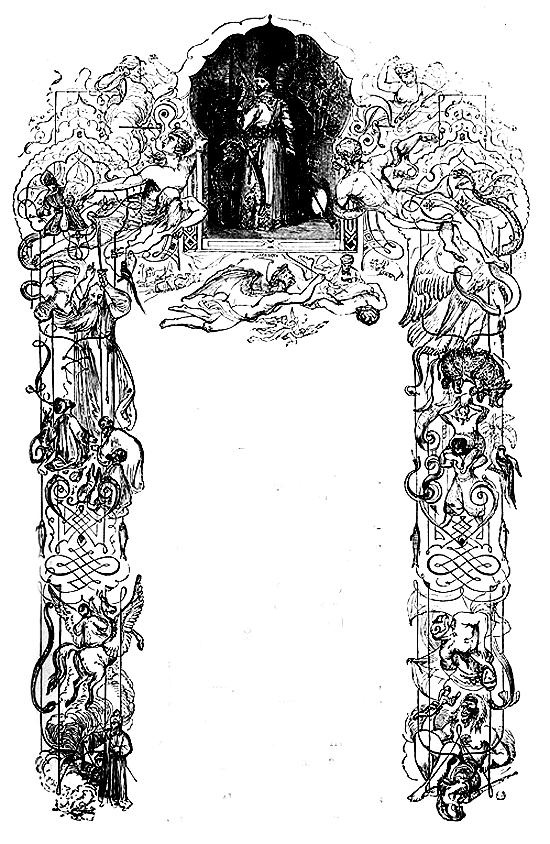
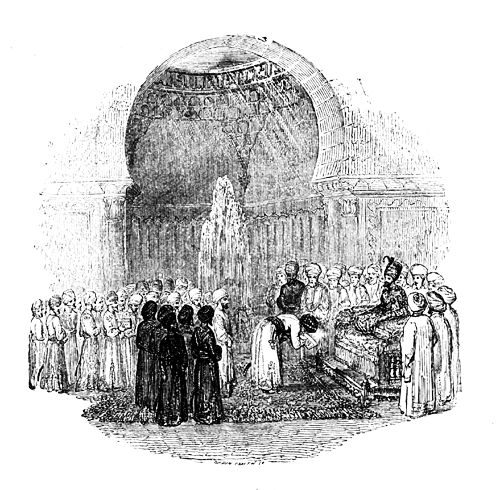
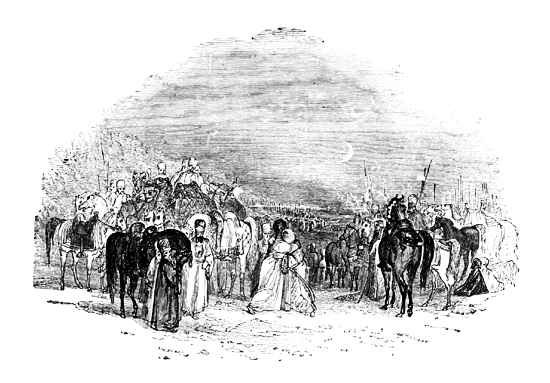
It has been stated, that, by means of talismans, or certain invocations,
men are said to obtain the services of Jinn; and the manner in which the
latter are enabled to assist magicians, by imparting to them the
knowledge of future events, has been explained. No man ever obtained
such absolute power over the Jinn as Suleymán, Ibn-Dáood (Solomon, the
Son of David). This he did by virtue of a most wonderful talisman, which
is said to have come down to him from heaven. It was a seal-ring, upon
which was engraved "the most great name" of God; and was partly composed
of brass, and partly of iron. With the brass he stamped his written
commands to the good Jinn; with the iron (for a reason before
mentioned), those to the evil Jinn, or Devils. Over both orders he had
unlimited power; as well as over the birds and the winds,[85] and, as is
generally said, the wild beasts. His Wezeer, Aṣaf the son of Barkhiyà,
is also said to have been acquainted with "the most great name," by
uttering which, the greatest miracles may be performed; even that of
raising the dead. By virtue of this name, engraved on his ring, Suleymán
compelled the Jinn to assist in building the Temple of Jerusalem, and in
various other works. Many of the evil Jinn he converted to the true
faith; and many others of this class, who remained obstinate in
infidelity, he confined in prisons. He is said to have been monarch of
the whole earth. Hence, perhaps, the name of Suleymán is given to the
universal monarchs of the preadamite Jinn; unless the story of his own
universal dominion originated from confounding him with those kings of
the Jinn.