12 illustration(s) from this book

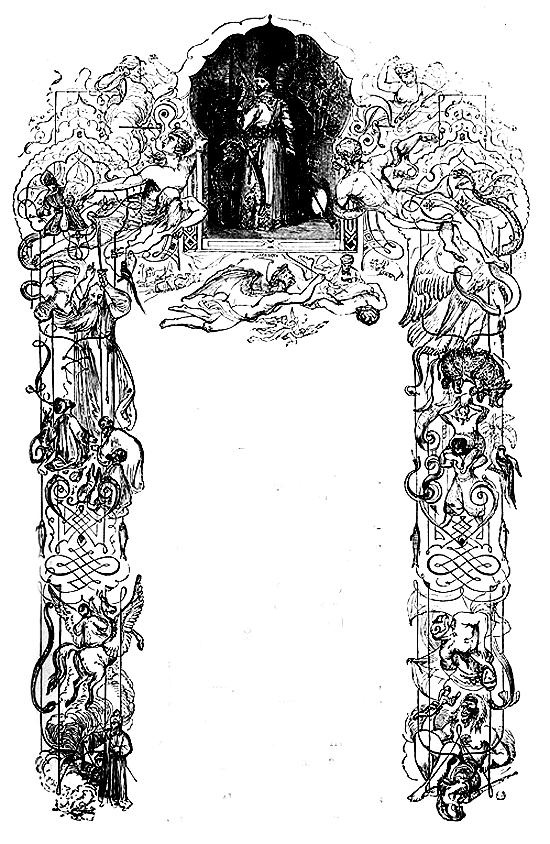
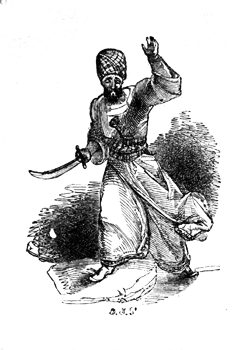
One of these is the Ghool, which is commonly regarded as a kind of
Sheytán, or evil Jinnee, that eats men; and is also described by some as
a Jinnee or an enchanter who assumes various forms. The Ghools are said
to appear in the forms of various animals, and of human beings, and in
many monstrous shapes; to haunt burial-grounds and other sequestered
spots; to feed upon dead human bodies; and to kill and devour any human
creature who has the misfortune to fall in their way: whence the term
"Ghool" is applied to any cannibal. An opinion quoted by a celebrated
author, respecting the Ghool, is, that it is a demoniacal animal, which
passes a solitary existence in the deserts, resembling both man and
brute; that it appears to a person travelling alone in the night and in
solitary places, and, being supposed by him to be itself a traveller,
lures him out of his way.[89] Another opinion stated by him is this:
that, when the Sheytáns attempt to hear words by stealth [from the
confines of the lowest heaven], they are struck by shooting stars; and
some are burnt; some, falling into a sea, or rather a large river
(baḥr), become converted into crocodiles; and some, falling upon the
land, become Ghools. The same author adds the following tradition:--"The
Ghool is any Jinnee that is opposed to travels, assuming various forms
and appearances;"[90] and affirms that several of the Companions of the
Prophet saw Ghools in their travels; and that 'Omar, among them, saw a
Ghool while on a journey to Syria, before El-Islám, and struck it with
his sword.--It appears that "Ghool" is, properly speaking, a name only
given to a _female_ demon of the kind above described: the male is
called "Ḳuṭrub."[91] It is said that these beings, and the Ghaddár, or
Gharrár, and other similar creatures which will presently be mentioned,
are the offspring of Iblees and of a wife whom God created for him of
the fire of the Samoom (which here signifies, as in an instance before
mentioned, "a smokeless fire"); and that they sprang from an egg.[92]
The female Ghool, it is added, appears to men in the deserts, in various
forms, converses with them, and sometimes prostitutes herself to
them.[93]