12 illustration(s) from this book


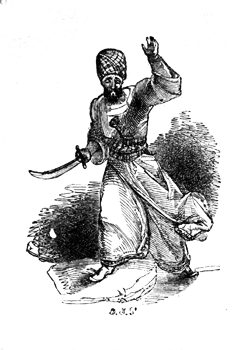
The Seạláh, or Saạláh, is another demoniacal creature, described by some
[or rather, by most authors] as of the Jinn. It is said that it is
mostly found in forests, and that when it captures a man, it makes him
dance, and plays with him as the cat plays with the mouse. A man of
Iṣfahán asserted that many beings of this kind abounded in his country;
that sometimes the wolf would hunt one of them by night, and devour it,
and that, when it had seized it, the Seạláh would cry out, "Come to my
help, for the wolf devoureth me!" or it would cry, "Who will liberate
me? I have a hundred deenárs, and he shall receive them!" but the people
knowing that it was the cry of the Seạláh, no one would liberate it; and
so the wolf would eat it.[94]--An island in the sea of Eṣ-Ṣeen (or
China) is called "the Island of the Seạláh," by Arab geographers, from
its being said to be inhabited by the demons so named: they are
described as creatures of hideous forms, supposed to be Sheyṭáns, the
offspring of human beings and Jinn, who eat men.[95]
The Ghaddár, or Gharrár (for its name is written differently in two
different MSS. in my possession), is another creature of a similar
nature, described as being found in the borders of El-Yemen, and
sometimes in Tihámeh, and in the upper parts of Egypt. It is said that
it entices a man to it, and either tortures him in a manner not to be
described, or merely terrifies him, and leaves him.[96]